

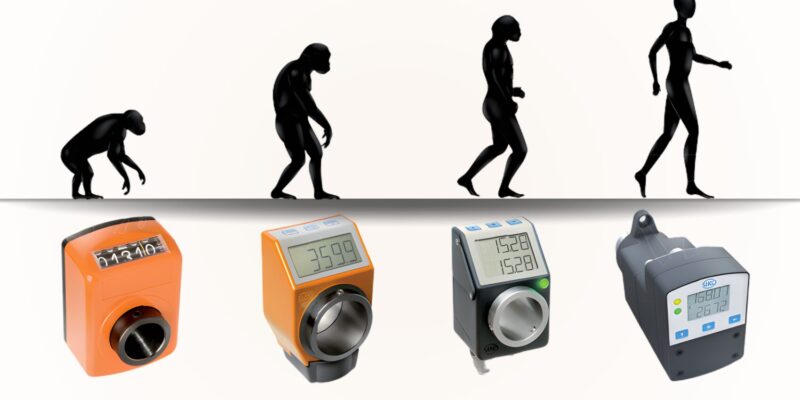
In the world of industrial automation, the push for efficiency often boils down to one factor: the speed and accuracy of machine setup. For over six decades, SIKO has been at the forefront of this movement. From their early days of simple mechanical counters to today’s intelligent, networked actuators, the evolution of SIKO technology mirrors the broader journey of Industry 4.0.
In partnership with Rajdeep Automation, we take a look at how SIKO actuators have evolved to become the “muscles and brains” of modern machinery.
The Mechanical Roots: The Handwheel Era
The story begins in 1963 with a simple but revolutionary idea: the hollow shaft position indicator. Before this, adjusting a machine axis was a matter of guesswork and manual measurement. SIKO introduced mechanical-digital counters that allowed operators to see exactly where a spindle was positioned. While these weren’t “actuators” in the motorized sense, they established the SIKO Principle: a compact, hollow-shaft design that slides directly onto a drive shaft. This philosophy of “simplicity in mounting” remains a core DNA strand in their modern electronic actuators.
The Leap to Automation: The “Compact” Revolution
As manufacturing moved toward semi-automation, the need arose for manual adjustments to be replaced by motors. SIKO’s evolution took a massive leap with the introduction of the DriveLine series—specifically the AG series of actuators. The turning point was the AG05. At the time, it set a global benchmark for compactness. By integrating the motor, gearbox, and sensor technology into a unit roughly the size of a soda can, SIKO made it possible to automate axes in tight spaces were traditional, bulky motors simply wouldn’t fit.
From Fieldbus to Industrial Ethernet
The next stage of evolution was focused on “communication.” Siko has evolved with the drives to offer different models with different torque and protocols. Today’s actuators, such as the AG25 and AG26, support Industrial Ethernet (Profinet, EtherCAT, and EtherNet/IP). This evolution allows actuators to be integrated into a seamless loop with the PLC, enabling “one-touch” format changes where dozens of axes adjust themselves simultaneously to sub-millimeter accuracy.
The “Smart” Actuator: Predictive Maintenance
The most recent evolution of SIKO actuators isn’t just about movement; it’s about intelligence. Modern SIKO actuators are now diagnostic tools. They don’t just move to a position; they report back on their own health.
Current models feature:
- Condition Monitoring: Tracking temperature and power consumption to predict a failure before it happens.
- Brushless Technology: Transitioning to brushless DC motors for a wear-free, maintenance-free lifespan.
- Absolute Sensing: Using magnetic sensing technology that remembers its position even after a power failure, eliminating the need for time-consuming “homing” runs.
Why It Matters Today
The evolution from the handwheel to the AGxx smart actuator has transformed the factory floor. What used to take a technician 30 minutes of manual cranking now takes 30 seconds of automated adjustment. This reduces downtime, eliminates human error, and allows for “Batch Size 1” manufacturing and allows controlled format changeover.
As SIKO continues to innovate, the focus remains on making actuators smaller, faster, and smarter—ensuring that the machines of tomorrow are more flexible than ever before.